
Asphalt Overlay vs Replacement: Which Does Your Pavement Need?
An overlay is the right call when the base under your asphalt is still solid. When the base has failed, replacement is the fix. Old cracks work their way up through a new layer laid over a broken base.
National cost guides put an overlay at about $3 to $7 per square foot. A full tear-out and repave runs about $8 to $15. At the middle of those ranges, an overlay costs less than half as much. The catch is that it only pays off on pavement that can carry it.
What is the difference between an overlay and a replacement?
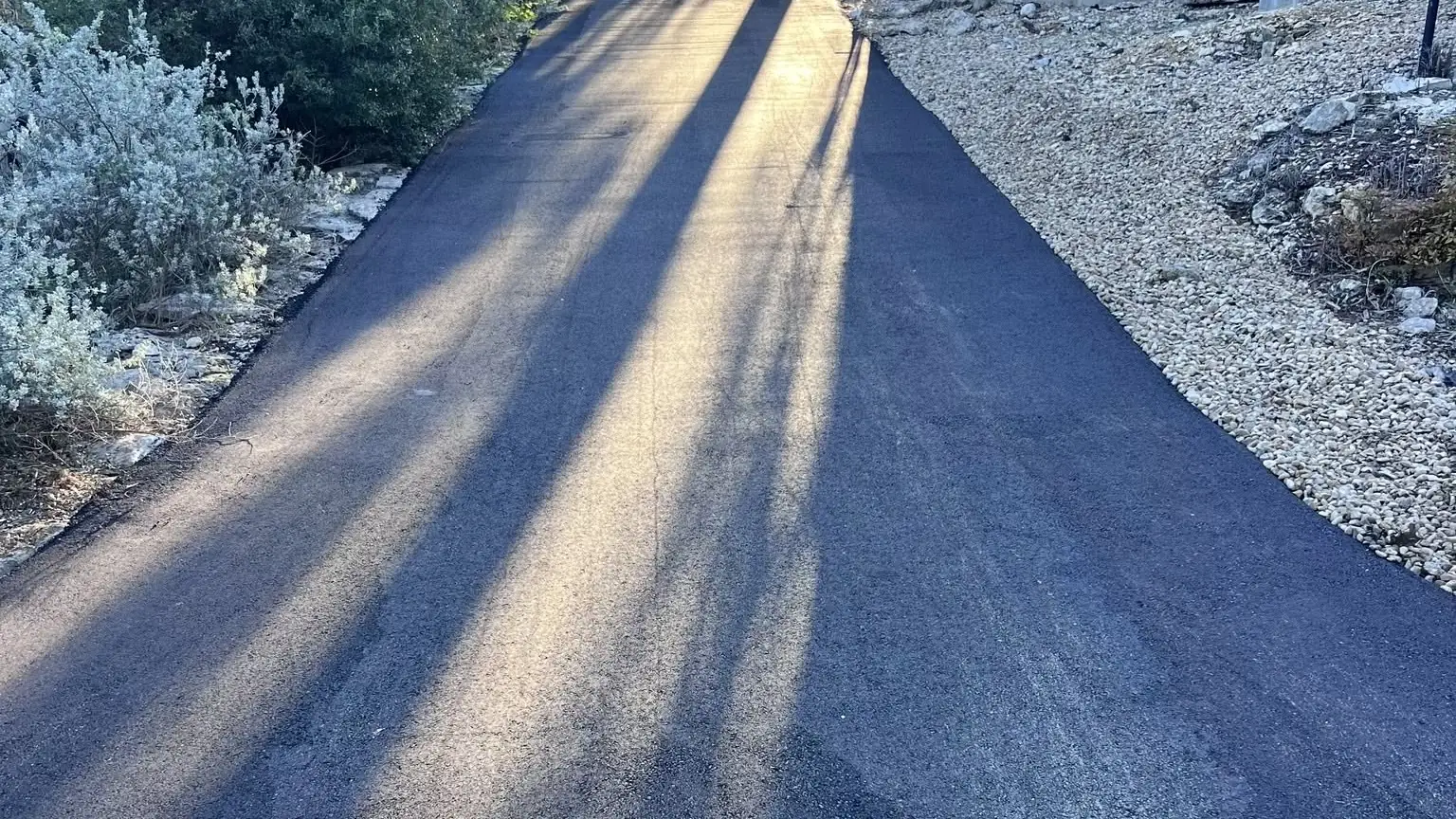
An overlay is a new layer of hot mix asphalt placed over the old surface. One national guide lists it at 1.5 to 2 inches thick. Contractors patch the holes and cracks first or mill off the damaged top layer.
A replacement takes the old asphalt out. The base underneath gets repaired or rebuilt, and new asphalt goes down. One national guide calls for 6 to 8 inches of compacted gravel base under a home driveway.
Our asphalt overlay jobs start with a check of whether an overlay will work on your pavement. Then we mill the top layer and replace the base in spots that need it. The new asphalt goes on last.
When does an overlay work?
An overlay fits pavement that is worn on top but sound underneath. One national guide lists these marks of a good candidate:
- Less than 25 to 30 percent of the surface needs repair.
- Cracks stay under a quarter inch to three quarters of an inch wide and 2 inches deep.
- The base is still in good condition.
- The pavement is less than 15 to 20 years old.
- The surface has faded to light gray, a sign of oxidized asphalt that cracks easily.
Repairs come before the new layer. A federal case study on Texas highway overlays describes one TxDOT district’s advice. Cracks wider than a quarter inch get repaired first. Damage that runs through the full depth of the pavement gets a full-depth repair. On a driveway or lot, that prep is asphalt repair work.
Which signs mean the pavement needs replacement?
Some damage starts below the surface, out of reach of a new layer. Watch for these signs:
- Alligator cracking. Highway agencies rate damage with a federal manual, and it calls this fatigue cracking. It forms where wheels pass again and again. Over time it breaks into many-sided pieces, usually under a foot across. One guide says widespread spiderweb cracks make replacement the better path.
- Pieces that move. In its worst stage, that manual notes the pieces may move under traffic.
- Deep cracks and many potholes. One guide lists cracks 1 to 2 inches deep and multiple large potholes as replacement signs.
- Widespread cracking. The same guide says cracks covering 60 percent or more of the surface call for replacement.
- Drainage trouble. Guides list slope and drainage problems as reasons to replace rather than resurface.
Ruts are a closer call. The federal manual defines a rut as a dip that runs along the wheel path. A pavement reference built with state highway agencies says deeper ruts should be leveled and overlaid. Heavy rutting gets checked for its cause first, since the ground under the pavement can be the source.
Old cracks come back, too. The federal case study cites research that cracks typically climb about one inch per year through a conventional overlay. That is why failed spots get fixed before any new layer goes down.
Central Texas soil and heat add their own wear. Federal soil descriptions for the two leading clays east of I-35 in Austin list high shrink-swell potential. In dry spells, they open cracks up to 3 or 4 inches wide. One national guide notes clay soils often need extra excavation and base material to prevent cracking and settling. Another notes that warm weather in hot regions can soften asphalt and bring more frequent repairs.
What does milling do before an overlay?
Milling grinds off the top layer of old asphalt. One national guide says it creates an even depth in badly damaged pavement. It also keeps new paving level with a garage floor or a sidewalk. The same guide notes that contractors haul the millings to an asphalt plant for recycling.
We handle asphalt milling with a skid steer planer, sized for driveways and small to mid-size lots. One national guide prices milling at about $0.25 to $0.75 per square foot, added to the overlay.
What do an overlay and a replacement cost in Texas?
These are market numbers from national cost guides, not our price list. The last column multiplies each range by 600 square feet, which one guide calls an average two-car driveway.
| Job | Market range per square foot | At 600 square feet |
|---|---|---|
| Overlay (resurfacing) | $3 to $7 | $1,800 to $4,200 |
| Milling the top layer first | $0.25 to $0.75 more | $150 to $450 more |
| Full replacement, removal included | $8 to $15 | $4,800 to $9,000 |
Removing the old surface makes up about $1 to $2 per square foot of that replacement range, per one guide. Another national guide runs lower, at $1 to $3 for resurfacing and $4 to $10 for replacement. One guide’s state chart lists a typical Texas asphalt driveway at $4,200 to $10,250.
Guides put a resurfaced driveway at 8 to 15 years. New or rebuilt asphalt lasts 15 to 30 years with upkeep.
Parking lots follow the same logic at a bigger scale. One guide lists lot resurfacing at $1 to $3 per square foot, or about $300 to $900 per space.
Your number moves with size, base repairs, milling, hauling, drainage work and access. Small jobs can also run into a contractor’s minimum charge.
How does a contractor decide between the two?
The pavement’s condition makes the call, and age is only one clue. An inspection looks at four things:
- The crack pattern. Narrow, scattered cracks can be filled. A web of cracks calls for a closer look at the base.
- Movement. Pieces that shift under a tire show trouble below the surface.
- Water. Where it pools or runs after a storm shows whether drainage is part of the problem.
- Height. Garage floors and curbs set how much milling the job needs.
One national guide adds a money test. When repair costs near half the cost of replacement, replacement may pay off in the long run.
Some pavement lands in between. Failed sections get cut out and rebuilt, and the rest gets a new layer. That mix of section repairs and a new layer is the core of asphalt restoration.
A replacement may also rebuild the approach where your driveway meets the street. Georgetown, for one, requires a permit to change or alter it. Your city’s permit office answers what applies to your job.
Not sure whether your pavement needs an overlay or a replacement?
We look at the pavement and put our answer in a written quote. If your pavement is a good overlay candidate, the quote says so. If the base has failed, the quote covers replacement instead. We serve Leander and the Austin area. Read how our asphalt overlay service works, then call or text (512) 369-2450 for a free quote.