
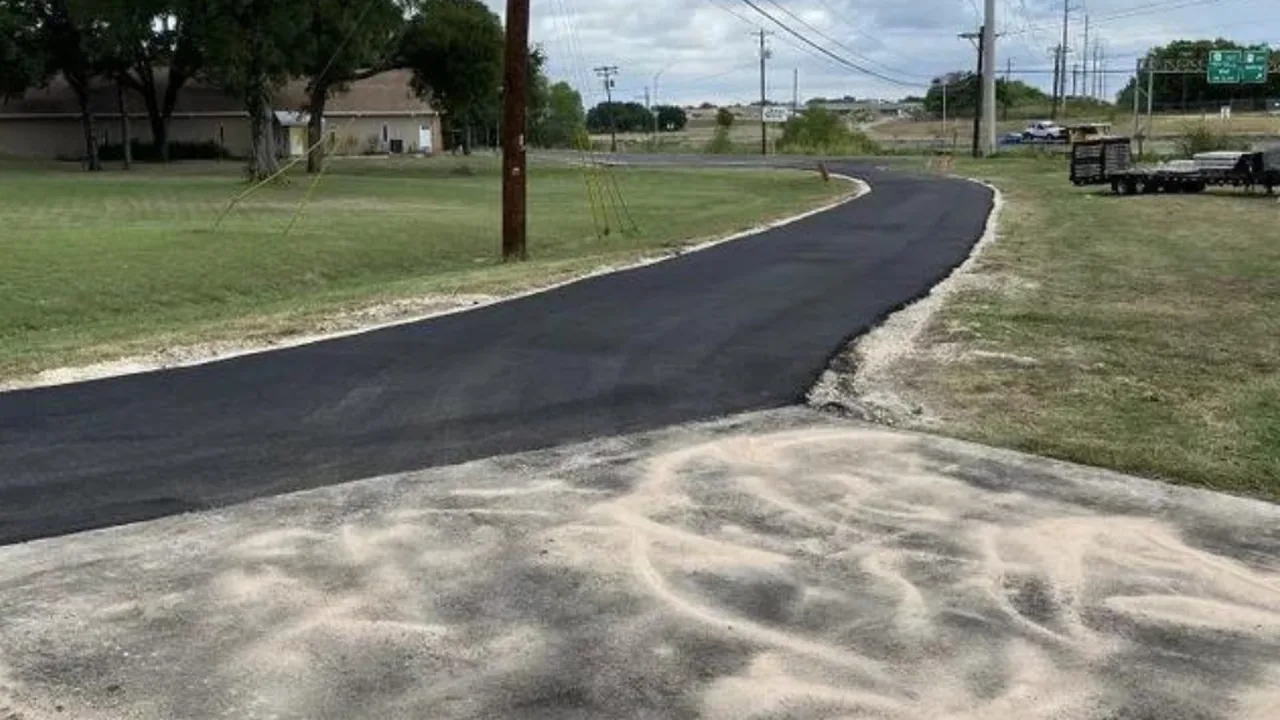
Chip Seal or Asphalt: Which Fits Your Texas Driveway?
Chip seal costs less up front and grips well on a grade. Hot mix asphalt costs more. In return, you get a smoother ride and a longer life. One national cost guide puts chip seal at $1 to $5 a square foot, with a $3 average. New hot mix runs about $7 to $15 a square foot across guides.
For a long rural drive in the Hill Country, chip seal often makes sense. For a short drive at a house in town, hot mix usually fits better. Pavement Solutions lays hot mix driveways and tar and chip seal across Leander and the Austin area.
What is the difference between chip seal and hot mix asphalt?
Chip seal is built in place on your drive. Hot liquid asphalt is sprayed over a prepared base or old pavement. Chip stone goes down right behind it. A roller presses the stone in, and the loose extra gets swept off.
The finished layer is about one stone thick, and the stone is small, often 1/4 to 3/4 inch. New work often gets two or three layers. The state highway department’s chip seal manual says the layer adds little or no strength. Its job is to seal out water and give tires grip.
Hot mix comes premixed from an asphalt plant, and a paving machine lays it. Then rollers pack it tight. An asphalt paving association’s driveway guide calls for a 2 inch bottom course and a 1.5 inch top course. It says 6 to 8 inches of crushed stone base underneath is usually enough. Hot mix is the material behind our asphalt driveway paving.
How much does chip seal cost compared with hot mix?
The ranges below come from national cost guides and the state highway department. They are market numbers, not our price list.
| Item | Chip seal (tar and chip) | Hot mix asphalt |
|---|---|---|
| New driveway, per square foot | $1 to $5, average near $3 | about $7 to $15 |
| 20 by 40 foot drive (800 square feet), one guide | about $2,400 | $5,600 to $10,400 |
| Highway work, per square yard | about $1 | about $5 for an overlay |
| Published life | about 5 to 15 years | about 12 to 30 years |
| Upkeep | a fresh layer of asphalt and stone | sealer every 2 to 5 years |
Chip seal prices swing more from guide to guide, and one lists $5 to $10 a square foot.
Length is where the gap grows. A 12 foot wide drive that runs 500 feet covers 6,000 square feet. At $1 to $5, that is $6,000 to $30,000 in chip seal. At $7 to $15, the same drive costs $42,000 to $90,000 in hot mix. That is rough math on guide rates, and your site sets the real number.
The state highway department sees the same gap on its roads. Its manual quotes about $1 a square yard for chip seal and $5 for a hot mix overlay. Driveway prices run far higher, but the gap points the same way.
Your own price turns on length, width, base work, slope and stone. One national guide notes that steep grades and stone shipped from far away add cost.
Which one looks right on your property?
Chip seal looks like a gravel road that stays put. The stone sits on top, so the stone sets the color. On our chip seal jobs, you can pick the stone color.
Hot mix is smooth and black. Sun and weather dull it over time, and a fresh coat of sealer brings the black back.
One national guide says chip seal does well in rural settings and on slow, low-traffic drives. Texas uses it as a routine top surface on new low-traffic roads. A short drive in a subdivision usually suits hot mix. If an HOA covers your lot, read its rules before you choose.
Which surface grips better on a slope or in the rain?
Chip seal does. The state highway department lists a skid-resistant surface among chip seal’s main jobs. The rough stone gives tires bite on a wet grade. That helps on Hill Country lots, which are often rocky and sloped.
Chip seal has two weak spots. Wheels turned hard can scuff stone loose, mostly while the seal is new. The surface also mirrors the base under it, so dips and humps show through.
Hot mix is the steadier choice where cars turn and park every day. On any slope, water runs fast. Good driveway grading sends it off the drive before either surface goes down.
How long does each one last, and what upkeep does it need?
Hot mix lasts longer. National cost guides list about 12 to 30 years for an asphalt driveway. An asphalt paving association says a well-designed driveway can serve up to 20 years without trouble.
Chip seal numbers swing with traffic. An asphalt industry group puts chip seal at five to eight years. Cost guides list about 10 to 15 years for a driveway. The state highway department reports six to eight years on its roads, and some have lasted 20.
For upkeep, a new hot mix drive needs no sealer for about 2 to 5 years. After that, a sealer every 2 to 5 years helps it last. Chip seal skips the sealer and gets a fresh layer when the stone wears thin.
What does Central Texas heat do to each one?
Austin’s Camp Mabry station averages 111 days a year at 90 degrees or hotter, per 1991 to 2020 federal normals.
Warm weather helps chip seal set, and the warm season here is long. The risk is too much binder, which can rise as a sticky black film in summer. The state’s manual calls excess binder one of the most common chip seal defects.
Hot mix softens in heat as well. One national guide suggests a thicker layer where hot climates soften asphalt. Keep heavy trucks off a new hot mix drive for the first few days.
When does each one fit?
Chip seal fits when:
- the drive is long and lightly used
- you want a stone look in a color you pick
- the drive climbs a grade and needs grip
- a lower first cost matters more than the longest life
Hot mix fits when:
- the drive is short and sits close to the house
- cars turn and park on it every day
- you want a smooth top for bikes and strollers
- you want the longest life before a redo
If you want stone with no asphalt at all, a crushed granite driveway is a third choice. City rules can narrow the field. Georgetown’s development code requires a paved surface on driveways. It counts chip seal and asphalt as paved, but not gravel or decomposed granite. If your lot sits inside a city, its permit office can tell you what counts.
On a long lot, you can split the job. Hot mix goes near the house, and chip seal runs the rest.
How do you get a price for your own drive?
Guide numbers only go so far, because every drive has its own base and slope. We look at the drive and put the quote in writing. It can price chip seal and hot mix side by side. Call or text (512) 369-2450, or see how we build a chip seal driveway.